Unless you know better, chances are you believe Backgammon is a simple game of luck. And it is a game of luck. Most matches are won by the luckier player. And in a match to 5 or 7 points, me, a lowly PR 10 or so player can sometimes beat a top player. In Chess, I can play a thousand games against a Grandmaster and will not win a single one.
But that doesn’t mean that there is no complexity in Backgammon. I find this shows best in positions that are almost trival. Positions where you may think you can compute the actual best move by applying probability theory. And at least I always fail, because even the simplest positions can be tricky to calculate in your mind.
Like this one:
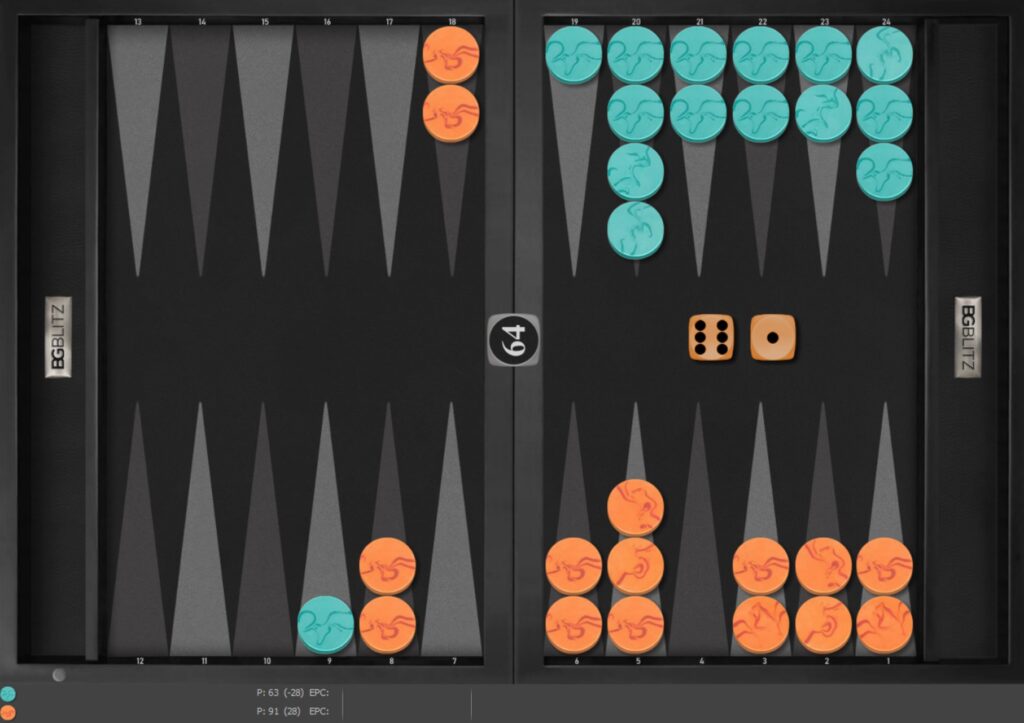
Match to 21. Red leads 14:4. He rolls a 61. What is the best move?
I love this layout of BGBlitz, but talking about the colors is weird. Is this orange? Is it green or blue? I go for orange and green 🙂
Orange is 28 pips behind. If green gets his checker past the two red stones, he most likely wins. And both have a strong 5 point board. If one of them hits he will most likely win.
Now red has two fundamental options: keep the two checkers on the 18 point and wait for the green checker to arrive for a lucky hit. Or split the two checkers with the 1, and double his changes to hit, but also risk the chance of being hit.
What do you think?
My thinking was: if I (I’m orange) do not split and play 8/2 8/7 or so, in all likelihood I will get a single direct hit afterwards. So in 10 out of 36 cases I will probably win after hitting. If I split the two checkers, the probability of getting hit with a 63 or 54 is only 4/36, while the probability to hit green is about twice as high – 20 out of 36, so the risk is worth it, particularly as I’m behind in the race.
And it turns out I was right 🙂
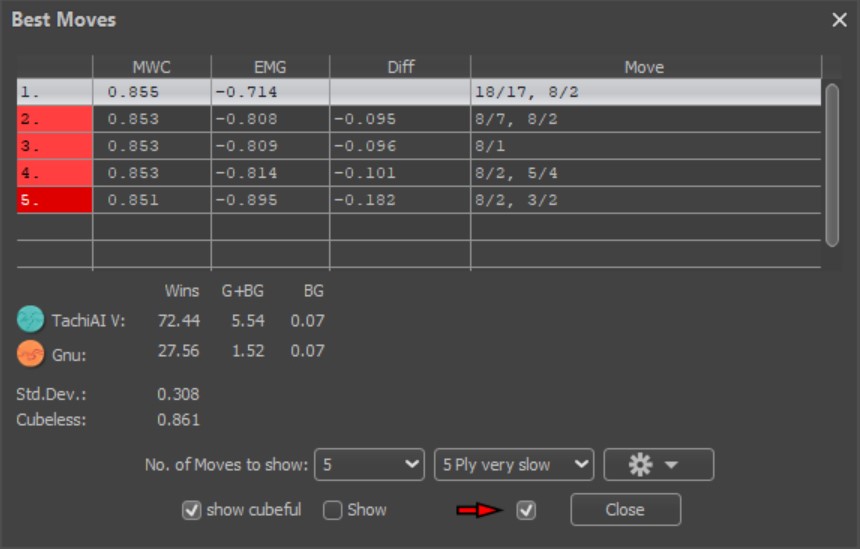
Splitting with 18/17 8/2 is the way to go. Not splitting is nearly 0.1 blunder.
By the way, in the actual game things didn’t continue smoothly. I split, resulting in a lot of hitting and lucky entering on both sides.